Band and Orchestra Kids Go To Church (Part 1)

Photo by Ludwig Kwan on Pexels.com

Yes, of course they do! Sadly, though, when I ask many Christian band and orchestra students if they have ever played in church the answer is most often “no.” I see this as a huge missed opportunity for connecting what our kids do outside of church with what happens on Sunday morning. Plus, student instrumentalists can add so much musical variety to our gathered worship. This series offers some practical ideas for getting them involved while addressing the unique challenges that often discourage both worship leaders and students.

Beginning to Engage Young Instrumentalists in Worship

It is challenging and time consuming to find a place for amateur musicians to actually serve congregational worship. Students’ skills are modest, and worship leaders may not be comfortable navigating the complexities of various instruments. We want the best quality music in our services. Yet, if we genuinely want to nurture an intergenerational community that uses their gifts to serve one another, it is important to find ways to engage with these young musicians. Here are some great places to start and a few guiding principles:

  1. Start with ensembles. Young players are not likely to be ready to play a solo in church. Find others like them and create a group to make music at their level. It doesn’t need to be a full symphony orchestra. Perhaps it is just a brass ensemble or a string ensemble or a balanced variety of instruments. Strive to make sure there is more than one player on each part, especially for the newest players.
  2. Pair them up with adults. My wife and I grew up sitting next to adult musicians (both professionals and amateurs) in church ensembles. Occasionally in the ensembles I have led, parents and their own kids have even played together. What an amazing intergenerational opportunity!
  3. Be mindful of their literacy. By literacy, I mean not only how well they can read music, but how well they can play by ear or improvise (“aural literacy”). A young Suzuki-trained string player, for example, might come with amazing technique and ear playing skills, but has not yet developed their reading skills. On the other hand, a student from school band may have strong note-reading skills, but has never learned by listening to a recording and may never have seen a leadsheet. Being attentive to this will help guide you to the right tools for success (more on this later).
  4. Don’t start too early. Players within the first two years or so of playing an instrument are probably not ready to play in a church ensemble. This doesn’t have to be a point of discouragement. In fact, when older students lead the way, the younger ones can look forward to the time when they are ready to begin playing in church.
  5. Make it positive. The biggest reason not to start too early is that it is absolutely essential that kids have a positive first experience doing this. In the next post, we’ll look at a few ways to begin plugging instrumental students into the gathered worship service.
A Major & Minor Scale Routine

Once you’ve become familiar with all of your major and minor scales*, it’s a good idea to keep playing them often.  Here’s a plan that can help you do that.  Rather than going around the circle of fifths or chromatically, we’ll follow this sequence of scales:

Major scale → Relative minor: Natural → Harmonic → Melodic →

Parallel Major → Relative minor: Natural → Harmonic → Melodic →

Parallel Major → Relative minor: Natural → Harmonic → Melodic →

Parallel Major → Relative minor: Natural → Harmonic → Melodic

You’ll notice that if you continued you would be back to where you began.  It looks complicated at first but it’s actual quite logical and takes advantage of two important music theory concepts:

  1. The major scale and its relative minor scale in natural form share the same notes, just a different pitch center (aka “tonic” – the first and last note of the scale)
  2. The melodic minor and the parallel major scale share all of the same notes except for the third.

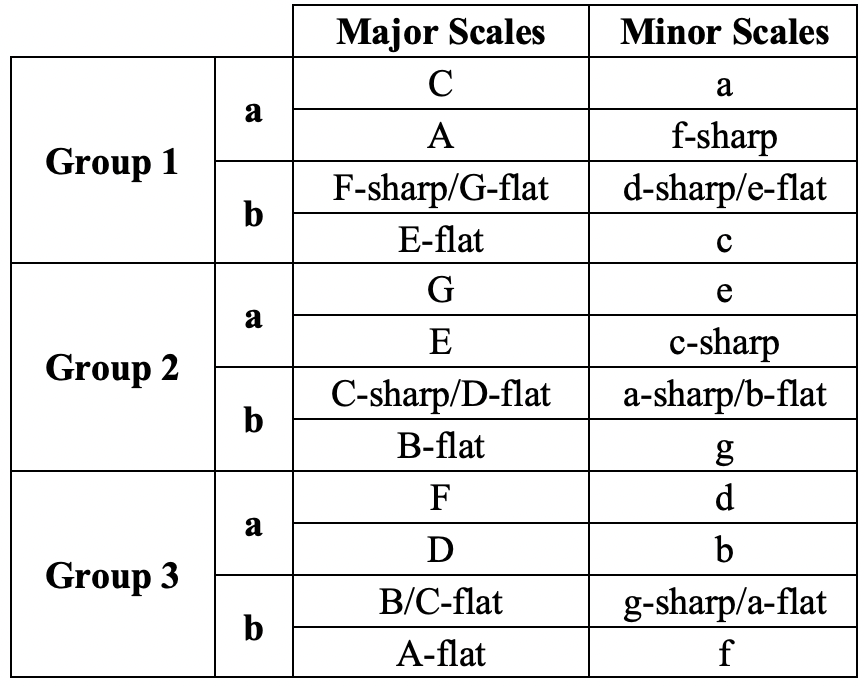
In all, there are three groups of these four major/minor scales.  Here is the sequence of the actual scales:

Remember, each minor scale should be played in three forms (natural, harmonic, and melodic).  For example, group 1 would be:

C Major → a natural → harmonic → melodic minor →

A Major → f♯ natural → harmonic → melodic minor →

F♯/G Major → d♯/e natural → harmonic → melodic minor →

E Major scale → c natural → harmonic → melodic minor

One of the nice things about this system is that it pairs scales that tend to be more familiar (like C or F) with those that are likely to be less familiar (like F♯ or C).   

Depending on your facility with all of these scales (and practice time available), you can fit them in a six day practice week routine by doing them all either once a week, twice a week, or every day.  Here are the three options in a schedule:

Tips:

  • Don’t forget to play these with a metronome.  Regardless of whether you can play them fast or slow, it will help you chart your progress and develop consistency.
  • Play each scale in one breath.  This forces you to maintain a steady tempo and develops consistency of approach.
  • Rather than starting scales from the bottom (up and back down again), try starting them from the top (down and back up again).  Why?  It develops a different kind of familiarity with the scales and increases your confidence in starting in the upper register.
  • Vary the articulation in every way imaginable, especially when you start knocking these all out every day.

*Use this handy Scale Journal to keep track of your progress learning your major and minor scales. It’s best to memorize your scales, but if you’re not there yet here are scale sheets for major scales and minor scales.

Practicing through Focused, Purposeful, and Creative Repetition

No matter how you do it, practicing is about doing something over and over again – repetition. I’ve found that there are three important ingredients that make repetition work for me. Rather than mindlessly hacking at a passage, I make sure that I’m approaching it over and over again with:

  1. Focus
  2. Purpose
  3. Creativity

I explain more and demonstrate the approach in this video:

Effective (& Enjoyable) Ways to Practice Sight-Reading

1.     Play something new.  Every day, read a piece of music that you’ve never seen before.  Your goal is to get through it, not play it perfectly.  And it doesn’t have to be challenging.  In fact, it’s better if you start with things that are one notch easier than what you might take a few or a few to learn.  

2.    Electronic resources.  SightReadingFactory.com as well as several other websites and apps provides great material.  If you’re studying music in school, be sure to play your aural skills exercises on your instrument.  Sight-singing texts provide well-sequenced material for developing this skill.

3.    Learn musical patterns.  The most obvious pattern in music is the scale, but even scales can be reimagined in different ways (for example, in thirds or the patterns in Clarke’s Technical Studies).  Try playing basic rhythmic patterns on each note of the scale and imagine what it would look like on the page.

4.    Find patterns in your music.  Good music readers see groups of notes, not individual pitches.  Music Speed Reading by David Hickman presents a unique method for learning to recognize rhythmic groupings and melodic patterns.

5.    Isolate pitch or rhythm.  Get good at reading just one of these, before putting it together.  Any piece of music can become a rhythmic exercise by playing it on one pitch.  Or play the pitches at a single steady pace without the rhythms.

6.    Use a metronome.  It can be painful, but the metronome is a good teacher, forcing us to maintain the steady pulse in the music we are reading.

7.    Play duets.  Find another trumpet player or another player on any instrument to play stuff together.  Playing with someone else keeps you from stopping and provides real-life accountability for rhythm, pitch, and intonation.

Amazing Grace Lip Slur

I try to approach even warming up and technical work with as much musicality as possible. It can be difficult to “feel it” when we’re playing lip slurs, in particular. But since the voice was our first instrument, songs are helpful at moving us away from managing the trumpet to making music through it. I realized that much of the first phrase of the well-known hymn, Amazing Grace, is a lip slur. So, I thought it would be a great way to approach what is a daunting task for many trumpet players.

Play these through with all fingerings, noting where valve changes are required. I included the first line text to remind us of how it goes. For even better results, sing each phrase through before playing.