In Praise of Scales for Beginning Trumpet Players

Learning a variety of scales is essential for all successful instrumentalists. These are the building blocks of our music-making. It is never too early to start learning scales. In fact, it’s the perfect place to start! Why??

  • Almost all music is created with a limited collection of pitches. When these are arranged in order you get a scale!
  • Practicing scales builds the motor coordination needed to reliably produce pitches in musical time.
  • Scales help our ears connect with the different roles that each pitch plays within the context of a key.
  • Scales can be used to strategically extend range both higher and lower.
  • Even young students are able to play in many more keys than most teachers realize. This builds confidence and prepares them to approach keys with more sharps or flats without fear.
  • Once a student knows a scale, it can be used to develop any number of techniques when strategically varied, such as with articulation and dynamics.

In my teaching of beginning students, I start out with a five note scale from C to G. Once that is achieved, I add one note to the top, progressing slowly so as to develop a good sound and to discourage tension. It may take several weeks or months to play up to a full octave. That’s okay. I then use the Beginning Scale Sheet below to move students through several keys, developing both range and familiarity with different fingering combinations. 

A few other suggestions:

  • A steady tempo, no matter how slow, is essential for learning scales. Playing them out of time indicates poor motor control and renders them useless when applied to real music.
  • Pay attention to breathing. Encouraging students to play in one breath will promote reliable control of both the fingers and the air. This inevitably results in better sound production. At first, strive for just going up or just going down in one breath. Then, aim for up and down in one breath. Surprisingly simple goals like this provide excellent motivation for young students
  • Practice scales, first slurred and then tongued. Slurring eliminates the challenge of coordinating the tongue along with everything else. But articulation should be added soon so as to develop an immediate release of the air and coordination between tongue and fingers.
  • I use scales along with lip slurs to develop range in different ways. They also present two interrelated ways to approach the trumpet – one based on moving within a partial using valves and the other moving across partials with only the air and lips.

Unfortunately, many beginning band methods introduce only a narrow selection of keys and scales in the prioritization of other things. However, I find it incredibly empowering for students to learn multiple scales. It primes them for what is up next. If you really want to open up the doors for more repertoire, greater technique, and a true freedom of expression, scales are essential!
Duet Parts for the 2023-24 ETSBOA All-East Audition Trumpet Etudes

I enjoyed writing duet parts last year for the Tennessee All-East audition etudes, so I thought I would do it again for my students and others. They are great for:

  • Playing with a classmate
  • Playing with your teacher
  • Playing with a recording on YouTube (or even make your own and play along!)
  • Sight-reading practice – remember that’s part of the audition, too.
  • Hone your rhythm. These will fit together perfectly, if you’re playing in time.
  • Improve your intonation. It’s easy to let intonation slide when we play by ourselves. Playing these along with someone else might highlight some places where you can play better in tune.
  • Hearing the etudes in a different way. They might surprise you, but might also give you some more musical ideas.
  • Having fun!

You can view or download them below. You’ll need the audition etudes available from your director. Let me know how you like them!

Duet Parts for the 2023 MTSBOA Mid-State Audition Trumpet Etudes

Try out these duet parts I wrote to go along with this year’s Tennessee Mid-State audition etudes. You can play them along with a friend, your teacher, or one of the recorded performances online. Not only is this great practice for the sight-reading part of the audition, but I find playing these super helpful for honing rhythm and intonation. If both parts are played well, the rhythm will fit together and the pitches should lock in harmoniously. It also might give you some additional musical ideas when you hear more than just one line of music. I’ve included versions below with both the etude and the duet part together as well as the duet part on the page by itself. I hope these will help you have a little bit of fun while you prepare for the audition!

Duet Parts for the 2022-23 ETSBOA All-East Audition Trumpet Etudes

When preparing for an audition, we often forget to practice for the dreaded sight-reading. But how do you practice reading something you’ve never seen before? By playing things that you’ve never seen before. What better way to practice sight-reading than playing duets with a friend!

I wrote these duet parts to go along with the upcoming East Tennessee State Band and Orchestra Association All-East audition etudes to give you something fun to sight-read. They also might give you a new perspective on the etude in terms of harmony, rhythm, and style. And they simply won’t sound good if you aren’t playing your etude in tune, in time, and with accurate rhythm.

Once you’ve sightread these, you can listen to a performance of these duets (see below) by Dr. Erika Schafer (Professor of Trumpet at University of Tennessee-Chattanooga) and myself.

Enjoy!

(Unfortunately, the etudes that go with these duets are available only to ETSBOA members and their students.)

A Major & Minor Scale Routine

Once you’ve become familiar with all of your major and minor scales*, it’s a good idea to keep playing them often.  Here’s a plan that can help you do that.  Rather than going around the circle of fifths or chromatically, we’ll follow this sequence of scales:

Major scale → Relative minor: Natural → Harmonic → Melodic →

Parallel Major → Relative minor: Natural → Harmonic → Melodic →

Parallel Major → Relative minor: Natural → Harmonic → Melodic →

Parallel Major → Relative minor: Natural → Harmonic → Melodic

You’ll notice that if you continued you would be back to where you began.  It looks complicated at first but it’s actual quite logical and takes advantage of two important music theory concepts:

  1. The major scale and its relative minor scale in natural form share the same notes, just a different pitch center (aka “tonic” – the first and last note of the scale)
  2. The melodic minor and the parallel major scale share all of the same notes except for the third.

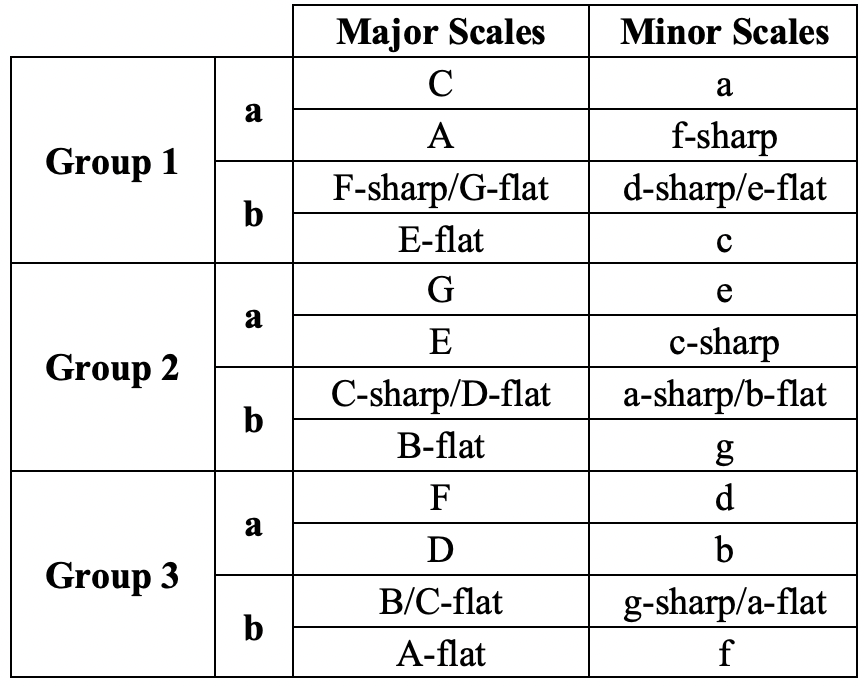
In all, there are three groups of these four major/minor scales.  Here is the sequence of the actual scales:

Remember, each minor scale should be played in three forms (natural, harmonic, and melodic).  For example, group 1 would be:

C Major → a natural → harmonic → melodic minor →

A Major → f♯ natural → harmonic → melodic minor →

F♯/G Major → d♯/e natural → harmonic → melodic minor →

E Major scale → c natural → harmonic → melodic minor

One of the nice things about this system is that it pairs scales that tend to be more familiar (like C or F) with those that are likely to be less familiar (like F♯ or C).   

Depending on your facility with all of these scales (and practice time available), you can fit them in a six day practice week routine by doing them all either once a week, twice a week, or every day.  Here are the three options in a schedule:

Tips:

  • Don’t forget to play these with a metronome.  Regardless of whether you can play them fast or slow, it will help you chart your progress and develop consistency.
  • Play each scale in one breath.  This forces you to maintain a steady tempo and develops consistency of approach.
  • Rather than starting scales from the bottom (up and back down again), try starting them from the top (down and back up again).  Why?  It develops a different kind of familiarity with the scales and increases your confidence in starting in the upper register.
  • Vary the articulation in every way imaginable, especially when you start knocking these all out every day.

*Use this handy Scale Journal to keep track of your progress learning your major and minor scales. It’s best to memorize your scales, but if you’re not there yet here are scale sheets for major scales and minor scales.