In Praise of Scales for Beginning Trumpet Players

Learning a variety of scales is essential for all successful instrumentalists. These are the building blocks of our music-making. It is never too early to start learning scales. In fact, it’s the perfect place to start! Why??

  • Almost all music is created with a limited collection of pitches. When these are arranged in order you get a scale!
  • Practicing scales builds the motor coordination needed to reliably produce pitches in musical time.
  • Scales help our ears connect with the different roles that each pitch plays within the context of a key.
  • Scales can be used to strategically extend range both higher and lower.
  • Even young students are able to play in many more keys than most teachers realize. This builds confidence and prepares them to approach keys with more sharps or flats without fear.
  • Once a student knows a scale, it can be used to develop any number of techniques when strategically varied, such as with articulation and dynamics.

In my teaching of beginning students, I start out with a five note scale from C to G. Once that is achieved, I add one note to the top, progressing slowly so as to develop a good sound and to discourage tension. It may take several weeks or months to play up to a full octave. That’s okay. I then use the Beginning Scale Sheet below to move students through several keys, developing both range and familiarity with different fingering combinations. 

A few other suggestions:

  • A steady tempo, no matter how slow, is essential for learning scales. Playing them out of time indicates poor motor control and renders them useless when applied to real music.
  • Pay attention to breathing. Encouraging students to play in one breath will promote reliable control of both the fingers and the air. This inevitably results in better sound production. At first, strive for just going up or just going down in one breath. Then, aim for up and down in one breath. Surprisingly simple goals like this provide excellent motivation for young students
  • Practice scales, first slurred and then tongued. Slurring eliminates the challenge of coordinating the tongue along with everything else. But articulation should be added soon so as to develop an immediate release of the air and coordination between tongue and fingers.
  • I use scales along with lip slurs to develop range in different ways. They also present two interrelated ways to approach the trumpet – one based on moving within a partial using valves and the other moving across partials with only the air and lips.

Unfortunately, many beginning band methods introduce only a narrow selection of keys and scales in the prioritization of other things. However, I find it incredibly empowering for students to learn multiple scales. It primes them for what is up next. If you really want to open up the doors for more repertoire, greater technique, and a true freedom of expression, scales are essential!

Inspiring Musicianship: String Playing Influences in H.L. Clarke’s Characteristic Studies

The following are resources from a presentation as part of the 2023 International Trumpet Guild Conference Research Room. For more background information, read the presentation abstract.

In the introduction to his Characteristic Studies, Clarke alludes to his source of inspiration for his etudes:

…I made a thorough study of violin methods and exercises, and adapting much of the material I found therein, for the needs of Cornet players. As a practical result the Twenty-four Characteristic Studies contained in this book, while of difficult grade, have been adapted from existing violin studies.

In fact, Clarke’s inspiration was Heinrich Ernst Kayser’s book of 36 Studies for violin published in 1848. All but two of Clarke’s etudes (16 and 24) can be traced back to an etude by Kayser.

Clarke/Kayser Comparison Chart

Clarke EtudeKeyMarkingKayser EtudeKeyMarking
1C MajorAllegro moderato4C MajorAllegro
2a minorAllegro28a minorAllegro assai
3D-flat MajorAllegro risoluto11E-flat MajorAllegro energico
4b-flat minorAllegro misterioso25d minorAllegro
5D MajorModerato energico8D MajorCommodo
6b minorModerato marcato19b minorAllegro
7E-flat MajorAllegro moderato32E-flat MajorAllegro moderato
8c minorAllegro agitato6c minorAllegro molto
9E MajorAllegretto guisto3F MajorAllegretto
10c-sharp minorAllegro moderato30d minorAllegro moderato
11F MajorAllegretto13G MajorAllegretto
12d minorAllegro moderato15B-flat majorAllegro moderato
13F-sharp MajorVivace22E MajorAllegro assai
14e-flat minorAllegretto con moto18G MajorAllegretto
15G MajorAllegro ma non troppo12G MajorAllegro, ma non tanto
16e minorTempo di BoleroAppears to be original to Clarke
17A-flat MajorModerato31A-flat MajorAllegro molto agitato
18f minorModerato23f minorAllegretto
19A MajorAllegro vivace27A MajorAllegro vivace
20f-sharp minorFurioso21E-flat MajorAllegro
21B-flat MajorModerato10C MajorAllegro, ma non tanto
22g minorAllegretto35b minorAllegro con fuoco
23B MajorModerato29C MajorModerato
24g-sharp minorAndante cantabileAppears to be original to Clarke

Examples for Comparison

Continuing in the introduction to the Characteristic Studies, Clarke emphasizes several goals of the studies including:

…absolute control of technic, articulation, slurring and endurance….

…[the studies] will help the student play with comfort and ease….

Cornet players should…try to demonstrate their own musical and artistic individuality.

Ex. 1: “articulation”

Kayser Etude #28
Clarke Etude #2

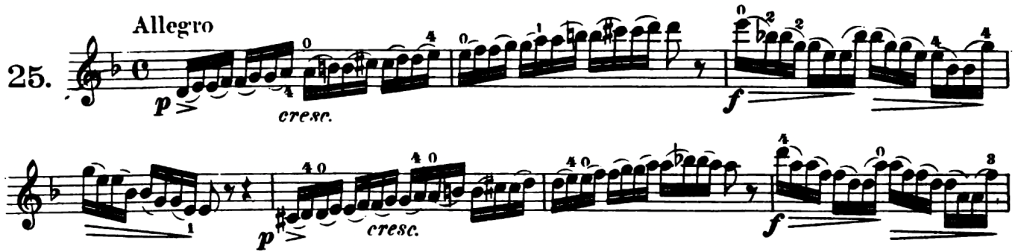
Ex. 2: “slurring”

Kayser Etude #25
Clarke Etude #4

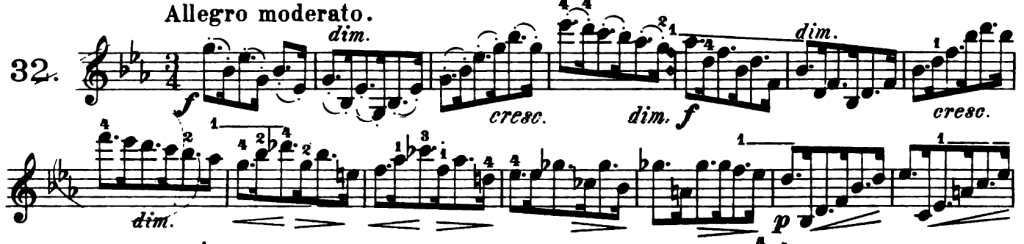
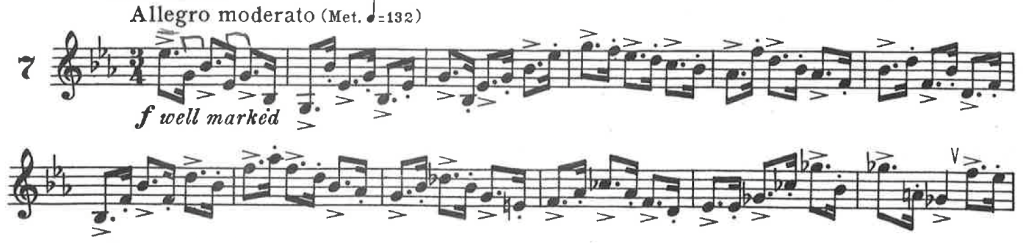
Ex. 3: “absolute control of technic”

Kayser Etude #32
Clarke Etude #7

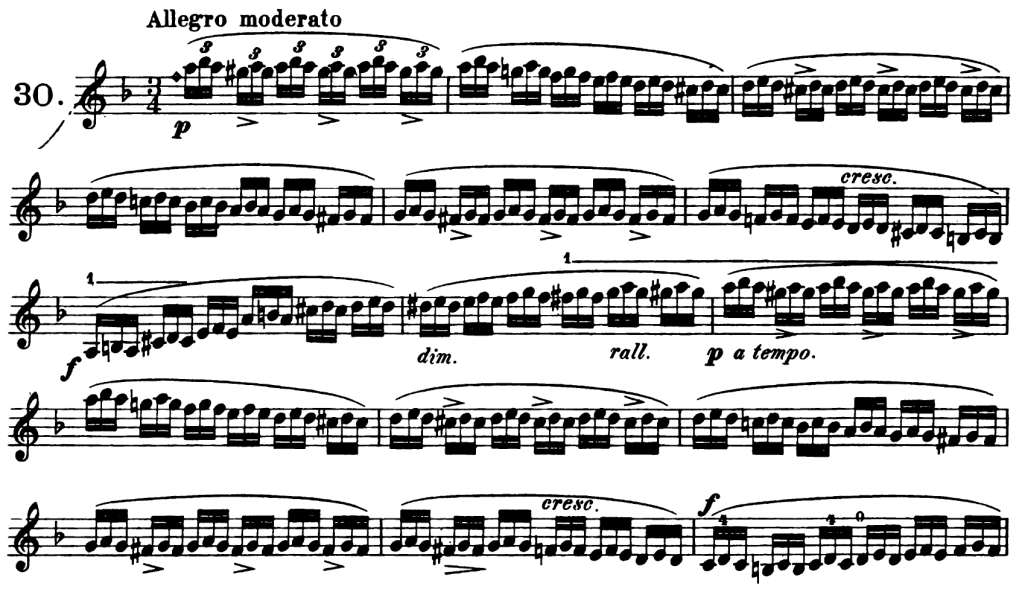
Ex. 4: “comfort and ease”

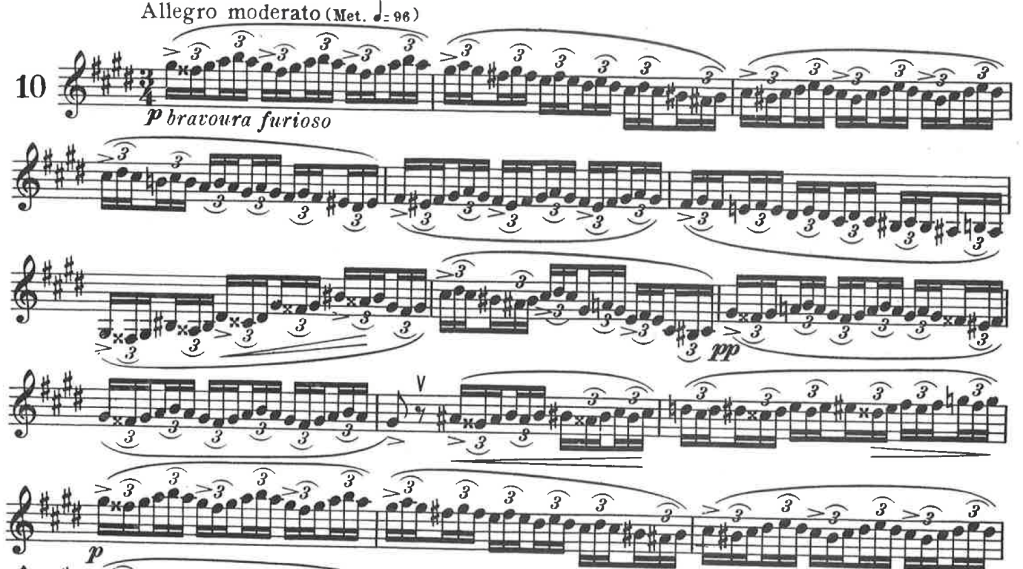
Kayser Etude #30
Clarke Etude #10

Ex. 5: “musical and artistic individuality”

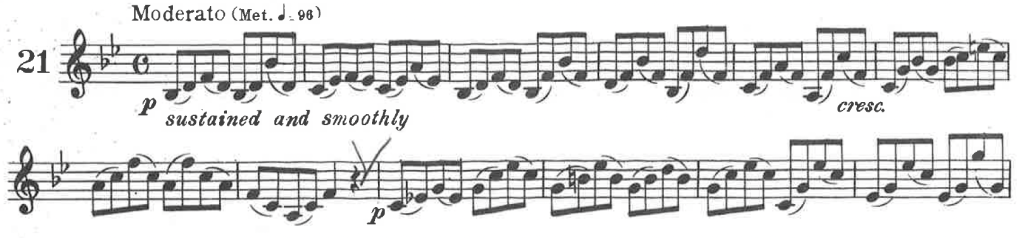
Kayser Etude #10
Clarke Etude #21

Sources and Resources

Bibliography

Clarke, Herbert L. How I Became a Cornetist. St. Louis: Joseph Huber, 1934.

Da Silva, Ulisses Carvalho. “Original and Transcribed Etude Books for Viola: A Reference Guide for Teachers and Students.” Ph.D. diss., University of Georgia, 2010.

Gillotti, Nicole. “Exploring Parallels between Trumpet and Violin Pedagogy: Relating Trumpet Adaptations of Otakar Ševčík’s Op. 8 to the Teachings of Vincent Cichowicz.” DMA diss., University of Illinois at Urbana-Champaign, 2020.

Madeja, James Thomas. “The Herbert L. Clarke Method of Cornet Playing” International Trumpet Guild Journal 14, no. 3 (February 1990): 4–18.

———. “The Life and Work of Herbert L. Clarke (1867-1945).” Ed.D. diss., University of Illinois, 1988.

Clarke Recordings

Schwartz, Terry. Characteristic Studies by Herbert L. Clarke. N.P., 2010, compact disc.

Wilt, Jim.  Clarke (or Clark) Characteristic Etudes 1, 6, 7, 9, 11, 12, 21.

Kayser Recordings

Cruz, Claudio. Kayser: 36 Violin Studies, Op. 20. Azul Music, 2020.

Kang, Bochan.  Kayser Violin 36 Etudes.

Etudes

Clarke, Herbert L. Characteristic Studies. New York: Carl Fischer, 1915.

Kayser, Heinrich Ernst. Elementary and Progressive Studies for the Violin, Op. 20. New York: Schirmer, 1915.

Full side by side compilation of Clarke’s studies with corresponding studies by Kayser:

ITG Conference Presentation

Duet part to Arban’s Theme from Caprice & Variations

Jean-Baptiste Arban

Duets are a fun way to work on so many things, including sight-reading, rhythm, intonation, dynamics, and basic ensemble playing. It’s best done alongside a friend — a trumpet player or any musician, really. But with technology, we can play duets with just about any recording. In order for my students to work on this theme from J.B. Arban’s Caprice & Variations (found in the back of your Arban’s method book), I wrote a little duet part and recorded both parts. You can download the duet music here and play along with either part here. So find a friend to play along or just play with me!

Original Theme (you play duet part)

Duet Part (you play the Theme)

Duet for Memorial Day

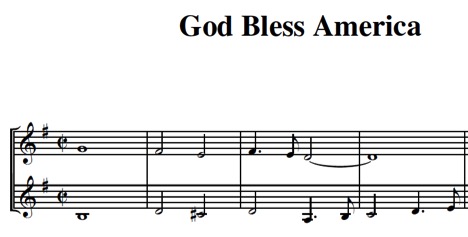
God Bless AmericaFor the past several years I’ve had the privilege of playing Taps in echo with a colleague as part of a Memorial Day service at a local cemetery.  It’s a helpful reminder to me of what this day of remembrance is really all about.  And I’m always aware of how the playing of Taps, in spite of its simplicity, is deeply meaningful to many people, especially those who have served in the military or who have loved ones who have.

We also usually play a fitting, two trumpet rendition of God Bless America.  Here are links to the simple arrangement in two different keys:

God Bless America in F

God Bless America in G